
Kickoff episode! Grant and Gabby battle leaf-blower chaos, explain why the show’s called Calm Down, It’s Just a Game, and lay out their “quadrants” framework to help athletes find the sport they truly love. They break down how to start volleyball by age (0–10, 10–18, 18+), why multi-sport kids develop faster, and how to stay in the game for life—whether you’re a Big-“A” athlete or just here for community, grass, and good vibes.
Gabby: Can I ask questions right now, or is this the final take?
Grant: This is not the final take; this is the first take. Go ahead and ask questions, and then we’ll just talk them out.
Intro: Welcome to “Calm Down, It’s Just a Game”—a podcast for volleyball parents, athletes, aspiring coaches, and the people who love them. With your hosts, Coach Grant Lange and Coach Gabby Gray.
Grant: I’m just trying to figure out if I can get this to work. We’re struggling with outside noises today, aren’t we?
Gabby: Oh, yeah. You can still hear it.
Grant: I can still hear the—what is that called? A leaf blower? It is such an American thing to have a leaf blower. You just blow all your problems into somebody else’s yard. I grew up raking stuff because we put it away and did our own thing. But welcome to our first episode of “Calm Down, It’s Just a Game.” I’m Coach Grant Lange.
Gabby: And I’m Coach Gabby Gray.
Grant: We are doing our first official episode. I think we’ve tried this about four different times! We are struggling with learning how to use the mics, especially as the leaf blower has come blowing by our tiny little studio. I’m excited to start this with you; we’ve been talking about this for a while. Coach Gabby and I have been coaching together for three years now.
Gabby: Three years. I think we’ve known each other for four in some capacity, but we’ve been coaching together for three.
Grant: One of the first conversations we ever had was about building a podcast.
Gabby: So, why do we call it “Calm Down, It’s Just a Game”?
Grant: It’s been fun trying to figure out a name that has universal appeal. There is nothing I have found that is more polarizing to someone interested in volleyball than saying, “Calm down, it’s just a game.”
Gabby: Yeah, I’ve heard that a couple of times from people and it just really made me mad.
Grant: Usually, it’s when I’m the most passionate. I’m coaching and I’m yelling, “That was a touch! That was a touch!” and then some parent leans over and says, “Oh, calm down, it’s just a game.” It’s the one time I actually consider yelling at my parents.
Gabby: I know when I was told that, I was playing in a recreational, non-competitive league just hitting the ball around.
Grant: And you were there to win! The biggest one we see is parents who are deeply involved in the development of their young athletes. They’re standing on the sidelines getting exercised, and then another parent looks at them and says, “Calm down.” But the reality is, it is just a game. I’ve been doing this for 30 years and you’ve been coaching for nearly 10; the message is right. The game is supposed to be about something more important than just playing.
Grant: We’re here to explain the “backside” of what we do professionally to parents, athletes, and other coaches. We want to give context to things like the changing environment of club ball, tryouts moving earlier each year, the panic of making a high school or middle school team, and the massive changes in the NCAA with NIL deals and the transfer portal. It’s hard for us to keep up, much less someone who is new.
Gabby: Exactly. Someone who is new.
Grant: “Calm Down, It’s Just a Game” is our way of giving you 30 minutes of calm before you go play.
Gabby: That brings us to our first episode: becoming an athlete—specifically a volleyball athlete—at any age. We get asked all the time about when and how to start, so we’re going to go over that today. During your time as a coach and an older athlete, what recommendations do you have about getting an athlete involved?
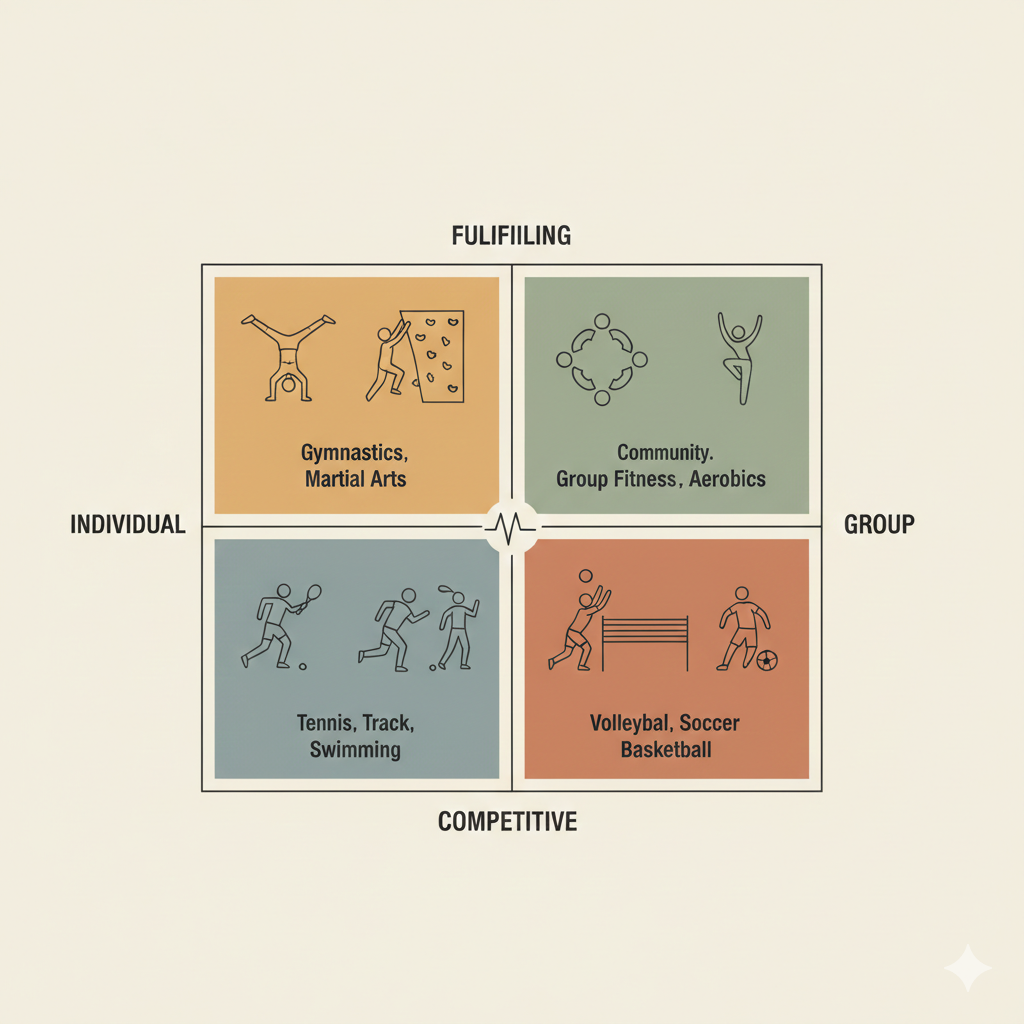
Grant: We do get asked this quite a bit. The answer is actually universal. We spend a lot of time trying to get into a specific thing, when the reality is we just want athletes to find something they love. Finding that is more about exploration than being focused only on volleyball. For example, I try to play tennis with my wife because she loves it, but it’s just not my makeup. I can’t stand on a court by myself and try to win; I’m in my head too much. But if I’m standing with five other people on a team, I can play. We like multi-sport athletes. We recommend a “quadrant-based” approach.
Gabby: How does that quadrant-based recommendation work?
Grant: Think of an X-axis: on one side is “Fulfilling” and on the other is “Competitive.” On the Y-axis, you have “Individual” versus “Group.” This gives us four categories: Fulfilling Individual, Fulfilling Group, Competitive Group, and Competitive Individual.
Gabby: Let’s start with Fulfilling Individual—focusing on self-growth and being motivated by what you like to do. Can you talk more about that?
Grant: That’s about focusing on your own growth. These are sports like gymnastics, tumbling, martial arts, skateboarding, dance, or climbing. They are athletic, but they aren’t inherently competitive until you make them so. The next stage is Fulfilling Group. For younger athletes, this is mostly playground games. You feel like part of something. As we get older, this becomes CrossFit, aerobics, or Zumba.
Gabby: Zumba! Or hip-hop dance.
Grant: Dance is a great group sport. Cheer is another.
Gabby: Wait, my doctor’s office is calling me… okay, go ahead.
Grant: The next quadrant is Competitive Group—focusing on teamwork to win. This is where traditional school sports live: baseball, basketball, volleyball, and soccer. This is the quadrant you and I live in most of the time. Finally, there is Competitive Individual: track, gymnastics, tennis, and golf. You’re trying to win, but you’re focusing on personal mastery rather than team dynamics.
Grant: We recommend that athletes experience something in each quadrant. Parents often get too focused on only the Competitive Group sports. If you explore all four, you find out who you are as an athlete. And when you find volleyball, you’ll find your people.
Gabby: So, how did you get involved in volleyball?
Grant: I’m going to back up. You’re about half my age, so I don’t really remember how I got involved, but I’m guessing you have some memory of it. What were your first athletic endeavors?
Gabby: I started with soccer and cheer. Cheer is more group-fulfilling, and soccer at that age was the same because we weren’t really keeping score. I also did some skateboarding in elementary school and climbing in high school. But I definitely thrived in a group setting.
Grant: My recommendation for parents with kids under 10 is to sign them up for something new every quarter. The goal is a broad range of experiences to build the ABCs: Agility, Balance, and Coordination.
Gabby: I think the athletes who get better are the ones who return, and the ones who return are the ones having fun. Under 10, the goal is fun.
Grant: Ages 10 to 18 is the meat of the experience. What was your first competitive experience?
Gabby: Middle school volleyball. I enjoyed the competition, but it was difficult socially because I was successful early. I was 11 years old on a middle school varsity team playing with 14-year-olds. There is a big difference between 11 and 14!
Grant: There is no right or wrong time to start. Parents often ask if their 14-year-old is starting too late. Of course not! I’ve seen kids start at 15 and go to college on a scholarship.
Gabby: In that 10–18 age group, you’ll see a lot of coaching and training opportunities. It can be overwhelming.
Grant: Your job as a parent is to get them involved in whatever is available right now. Support them, make sure they’re having fun, and then get out of the way so they can have their own experience. While they are playing, start looking for their next opportunity. Gabby, what are your “whys” for coaching?
Gabby: Being a mentor is the big one. I love being a mentor to the “littles” or anyone entering the sport. Most athletes start between 10 and 12, and that’s where they learn to love the game.
Grant: At ages 10 to 12, we start to see motivation develop. You have the competitive athlete who thrives on the score, and the fulfillment athlete who just wants to master the skills.
Gabby: That was me—the competitive one.
Grant: Interestingly, the ones who focus on mastering skills often end up being the fiercest competitors. The takeaway for this age is to talk to the coaches in your area and find one you gel with. Now, for the 18-plus crowd, I love the lifelong athletes. I see kids who played in the NCAA and then say, “I’m done.” It blows me away.
Gabby: We talk about the transition of the “Big A” Athlete versus the “small a” athlete.
Grant: A “Big A” athlete is when the sport is part and parcel of who you are.
Gabby: That was my journey. Transitioning from an NCAA athlete to someone who just plays pickup games was hard. It was my defining role. When that structure went away, I didn’t know who I was. It took me years to realize I could just be a “small a” athlete—someone who plays for community and fun.
Grant: It is a jarring transition. How did you get back into it?
Gabby: I started coaching, and then friends dragged me to local leagues. Sometimes you’d play ex-college athletes, and sometimes people who were just starting. It brought me back as a “small a” athlete—it was more community-driven.
Grant: My experience was similar. I was a four-letter basketball guy in high school, but I haven’t touched a basketball since. I got roped into volleyball and it became my ongoing experience. It’s the secret nobody knows: it’s a sport you can play for the rest of your life because it’s non-contact. It’s co-ed, and the language of volleyball has been my entrance into the world in so many ways.
Gabby: I play pickup regularly and a lot of grass in the summer. Grass pickup also tends to be more laid back. There are no referees; you call your own stuff and just banter between points.
Grant: To wrap up: if you’re a parent, give your kids those quadrant experiences. If you’re 18-plus, keep playing for the community. So, to end our first podcast, Gabby, what has driven you the most nuts in volleyball lately?
Gabby: My league the other night. Sometimes athletes just don’t want to be coached—their minds are somewhere else. I have all this passion and knowledge to help them, and they’re just rolling their eyes!
Grant: There is nothing more maddening than a kid who doesn’t want to be there. But sometimes you have to remember…
Gabby: Calm down. It’s just a game.