

Building a Better Foundation: Is Your Child Specializing Too Soon?
As parents, we all share a common goal: we want to give our children the best possible footing for the future. In the world of sports, that often feels like a race against time. We see other kids starting private lessons at age seven or joining elite travel teams by nine, and it’s natural to feel a sense of urgency. We worry that if we don’t pick a “main” sport right now, our child will fall behind. But here’s the secret that decades of coaching has taught us: the best way to give your child a competitive edge isn’t to narrow their focus—it’s to widen it. When we rush into specialization, we often trade long-term athletic potential for short-term results.
The problem is that many of us are unknowingly stuck in a single corner of the athletic world. We sign our kids up for the same types of team sports season after season, thinking we are building “experience.” In reality, we might be leaving huge gaps in their physical and emotional development. To build a truly resilient athlete, we need to look at a broader map. We think of athleticism in four distinct areas, or quadrants. By ensuring your child spends time in each one, you aren’t just helping them find a sport they love; you’re giving them the physical tools—the agility, balance, and coordination—that they simply can’t get from playing one sport alone.
“We spend a lot of time trying to get into a specific thing, when the reality is that what we really want athletes to do is to find the thing that they love.”
Think of these quadrants as different “athletic languages.” On one axis, you have Fulfilling activities—where the reward is the movement itself—versus Competitive ones, where the goal is to test yourself against someone else. On the other axis, you have Individual versus Group settings. Most youth sports programs live entirely in the “Competitive Group” corner. If that’s the only language your child speaks, they miss out on the self-reliance of individual sports and the internal mastery of fulfilling ones. A child who spends a season in a “Fulfilling Individual” sport like martial arts or climbing often develops a level of body control that makes them a standout player when they return to a team environment later on.
Our recommendation for parents is to intentionally rotate through these experiences, especially before the age of ten. This variety is what prevents burnout and protects against the overuse injuries we see so often today. It allows a child to discover if they are motivated by the scoreboard, the huddle, or the personal challenge of mastering a difficult movement. When a child finds the quadrant that fits their personality, the “work” of practice disappears and is replaced by genuine passion.
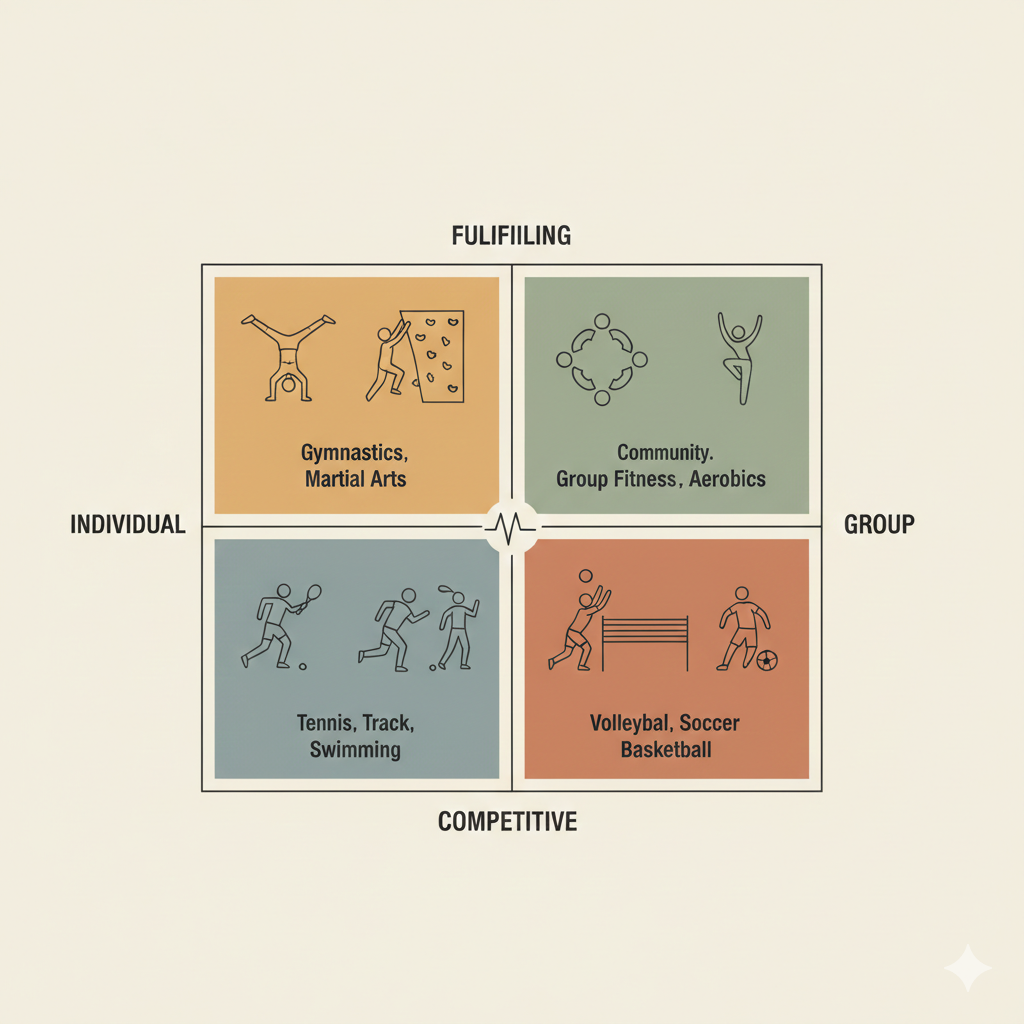
- Fulfilling Individual: Activities like gymnastics, dance, or skateboarding. The focus is on "Can I do this?" and mastering personal movement.
- Fulfilling Group: Community-based movement like non-competitive cheer or playground-style games where the joy is in the shared connection.
- Competitive Individual: Tennis, track, or swimming. These build massive personal accountability and mental toughness.
- Competitive Group: Traditional team sports like basketball or volleyball, focusing on communication and shared strategy.
"The athletes who get better are the ones who return, and the athletes who return are the ones who are having fun. Under 10, the goal is fun."
Ultimately, the best athletic footing you can give your child is a broad identity. We’ve seen many high-level athletes struggle when their time in the spotlight ends because their entire sense of self was tied to a single jersey. We want to avoid that "identity crisis" by helping them become lovers of movement first and players of a specific game second. A child who has explored all four quadrants knows that they are an athlete regardless of the score or the season. They develop a "Small A" athlete mindset—a lifelong love for being active that carries them long after the school years are over.
"It was my defining role. When that structure went away, I didn't have any kind of structure or sense of self... I was kind of like, who am I?"
The next time you're looking at a registration form, take a look at the map instead. Ask yourself: "Which quadrant hasn't my child explored yet?" Providing that variety is the greatest gift you can give their development. It builds a foundation that isn't just strong—it’s permanent. It ensures that when they finally do choose to specialize, they do so with the coordination of a gymnast, the accountability of a runner, and the heart of a teammate.
Which of the four quadrants has your child enjoyed the most so far? We’d love to hear about the sports or activities that have sparked their passion in the comments below.